
Public evidence supports testing guided makeup practice and professional trial records, but does not establish willingness to pay for a new foldable app.
This report compares six directions through product references, search samples and practical experiments.
Images and the step interface are original concepts, not shipped apps or native device tests.
BUILD = test a small version; WATCH = gather evidence; KILL = do not pursue this round. Search volume, KD, CPC and trend are unknown. Concepts are not implemented product claims.
Try the step layout
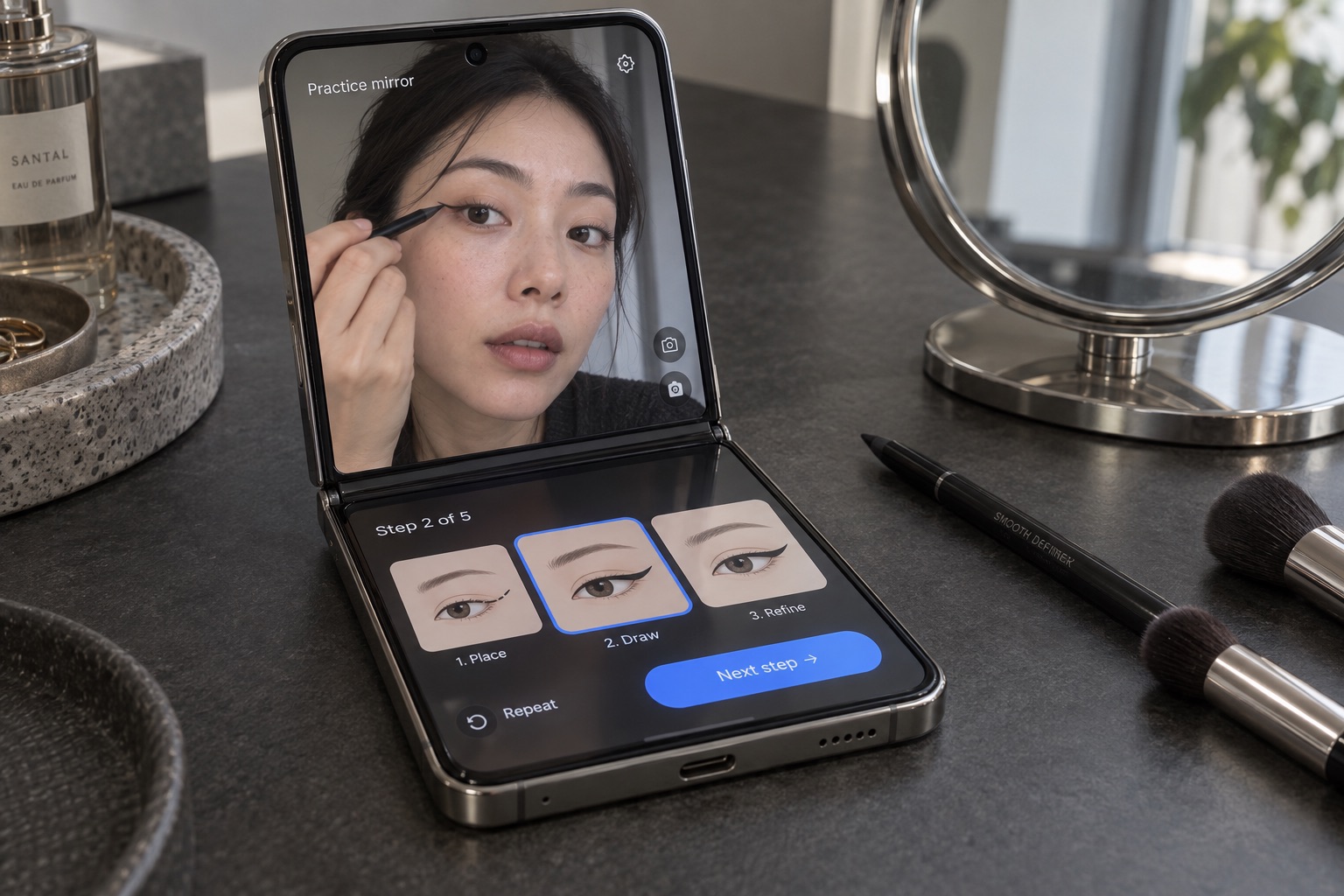
This is an interface demo: no camera access, makeup instruction or native app. The buttons demonstrate step navigation.
Mirror region · illustration
Change steps to explore the control area.
Opportunity board
Open a card for references, scope, payment hypotheses and stop conditions. Book means side-by-side inner-screen regions; tabletop means upper/lower regions. Inner/outer displays are a separate pattern.
Makeup practice mirror
See your own application and the current instruction while learning eyeliner.
Evidence and validation
- Observed reference
- Historical reviews of FaceEcho, formerly ForeverBeauty under the same app ID, describe tutorial-plus-camera viewing. SWAN sells a guided smart mirror. Foldable willingness to pay remains untested.
- First version
- Start with one eyeliner technique: five licensed instruction cards, explicit left/right mirroring, pause and replay. Validate with a webcam page, without automated beauty scoring.
- Payment hypothesis
- Free basic technique; test a one-time lesson pack. Consider subscriptions only after repeat practice.
- Constraints
- Camera latency, gaze angle, hand occlusion and glare may make an optical mirror preferable.
- 14-day test / stop condition
- Recruit 10 beginners; compare phone video plus a mirror with guided camera viewing. Record completion, mis-taps, gaze switches and a second session. Pause native work if most prefer the existing setup.
- SEO
- makeup tutorial mirror app · hooded eye eyeliner tutorial
Makeup artist lookbook
Recreate an approved bridal trial with its products and revision notes.
Evidence and validation
- Observed reference
- Total Beauty Planner offers bridal profiles, inspiration and consultation records; MYKITCO FACECHARTS LOG records products, techniques and references. These show workflow supply, not verified profit.
- First version
- Tie each photo to a versioned product list and export an approval PDF. Start with a web form and comparison view.
- Payment hypothesis
- Test paid exports or a small professional pilot; later charge per seat. Avoid building booking and payments at the same time.
- Constraints
- Client photos need consent and deletion controls. Unfolding helps consultation but is not essential.
- 14-day test / stop condition
- Ask five artists to recreate one consented trial record each. Track reuse and paid exports. Stop if existing tools suffice and nobody wants to switch.
- SEO
- makeup artist client record app · bridal makeup consultation form
Beauty creator capture desk
Check framing, product names and the next shot while filming tutorials.
Evidence and validation
- Observed reference
- Apple demonstrates outer-display camera prompting; PromptSmart sells prompting software. The beauty-specific shot checklist is a proposal.
- First version
- A checklist for product close-ups, half-face comparisons and finished looks, linked to captured clips.
- Payment hypothesis
- Test shot templates first; offer a professional subscription only if segmented capture and clip management repeat.
- Constraints
- Accessory availability is constrained; arbitrary background dual-display use is not assumed. Basic prompting faces platform and incumbent substitution.
- 14-day test / stop condition
- Have five creators film two short tutorials and compare missing shots and retakes. If a template solves the problem, keep the web product.
- SEO
- beauty video shot list · makeup tutorial teleprompter
Recreate a look with your kit
Check whether owned eyeshadow and lipstick can recreate a reference look.
Evidence and validation
- Observed reference
- Makeup inventory and look logging products exist; mapping a reference to owned products still needs validation. A photo cannot establish exact shades.
- First version
- Manually add ten products and annotate one reference look with owned products. Validate data-entry friction first.
- Payment hypothesis
- One-time organization and export purchase; affiliate suggestions only after a user identifies a missing product.
- Constraints
- Catalog entry is costly and products change. Automatic color matching lacks validated accuracy.
- 14-day test / stop condition
- Ask eight palette owners to catalog and recreate a look once. Stop if nobody returns after setup.
- SEO
- makeup inventory app · shop my stash makeup looks
Cross-brand foundation matching
Use a known matching foundation to shortlist another product and inspect swatches.
Evidence and validation
- Observed reference
- Findation maps known shades across brands and offers merchant integration. This supports purchase intent and a B2B model, not an automatic opening for a new entrant.
- First version
- Start with one narrow brand pair and licensed, auditable swatch comparisons. Secure data before development.
- Payment hypothesis
- Affiliate sales or merchant embedding, with attributable purchase conversion.
- Constraints
- Lighting, camera processing, oxidation and batches affect color. Large datasets are hard to reproduce; exact matches cannot be promised.
- 14-day test / stop condition
- Deliver ten manual matches within one brand pair and collect post-purchase feedback. Stop without usable swatch data or an advantage over existing tools.
- SEO
- foundation shade finder · foundation shade match
General AR makeup try-on
Preview lipstick, eyeshadow and blush on your own face before buying.
Evidence and validation
- Observed reference
- YouCam Makeup and its web products already offer live or photo try-on, makeup transfer and premium features.
- First version
- Do not build a general product in this round. Reopen only with a specific task or exclusive distribution advantage.
- Payment hypothesis
- Incumbents use consumer subscriptions and brand software; this project has no payment evidence.
- Constraints
- Commoditization, model and licensing costs, skin-tone coverage and inaccurate rendering. A larger screen is not a moat.
- 14-day test / stop condition
- Run only five alternative-solution interviews. Close this direction if free YouCam already solves the task.
- SEO
- virtual makeup try on · AI makeup filter
Research date: September 14, 2026, Asia/Shanghai. Scope: beauty software and book-style foldables. Evidence primarily comes from public English-language search, the US App Store and product websites. Chinese search demand remains unverified.
Judgment
Beauty software has observable demand signals: users have described camera-plus-tutorial viewing, professional products support client records, and companies sell virtual try-on and guided mirrors. These are separate from evidence that folding improves a task or that someone will pay for a new app. The latter two remain untested.
Prioritize a makeup practice mirror for beginners and a bridal trial record for professionals. The mirror best tests posture benefits; the record has a clearer professional customer. Choose one small test before building a complete app. BUILD means test, WATCH means gather evidence, and KILL means do not pursue this round. None predicts revenue.
Evidence ledger
| Source | Observed evidence | What it supports | What remains unknown |
|---|---|---|---|
| FaceEcho, App ID 1438735059 | Historical pages use the ForeverBeauty name. Reviews dated March 28, 2019 describe seeing a tutorial beside the front camera and fewer shifts between video and mirror | A specific, historically reported workflow problem | Current retention, revenue and foldable preference |
| SWAN | Official mirror list price is $795, including the first membership year; renewal is $9.95/month or $94/year | A commercial offer combining hardware and guidance | Sales, profit and transferable app pricing |
| Total Beauty Planner | Bridal profiles, inspiration photos, consultation records, products and shades | A professional record-keeping workflow | Paid customers, usage frequency and profit |
| MYKITCO FACECHARTS LOG | Product, technique and reference-image records | The need to document repeatable looks | Whether a new tool can replace the existing workflow |
| Findation | Known-shade matching and merchant integration; database scale is company-reported | Purchase intent and a merchant software model | Accessible data, active users and accuracy for a new entrant |
| YouCam | Virtual try-on, photo processing and premium features | Mature supply and an established commercial model | An acquisition advantage for a foldable newcomer |
| UR Artist | Describes switching between tutorials and mirrors as a problem and offers AR guidance | Direct competition for guided application | Independent adoption and payment evidence |
Sources: FaceEcho, SWAN, Total Beauty Planner, MYKITCO, Findation, YouCam, UR Artist.
Six directions
The six cards above specify the job, reference, first version, payment hypothesis, constraint and stop condition. Test the practice mirror for ergonomics and the professional lookbook for commercial willingness. Watch creator capture, owned-product look recreation and narrow shade matching. Do not build general AR try-on in this round: established competitors already cover the broad task.
A technique-specific eyeliner lesson can be the first content entry for the practice mirror. Let users select it themselves. Do not start by classifying their face from a photograph or scoring their appearance.
Gefei search record
Public web search and page reading were used on September 14, 2026. These are returned-result samples, not a controlled, fixed-region Google top-ten audit. Search volume, keyword difficulty, CPC and trend curves were unavailable and remain unknown. Result counts, ratings and company claims were not converted into search demand estimates.
| Query cluster | Observed result types | Intent | Interpretation |
|---|---|---|---|
| makeup tutorial mirror app / makeup mirror tutorial split screen | FaceEcho store listing and UR Artist product page | Find an actionable practice tool | Specific task with direct competitors; test step controls and camera usability |
| hooded eye eyeliner tutorial / hooded eye makeup step by step | L’Oréal article, creator videos and teaching websites | Learn one technique through demonstration | A licensed step guide plus a working practice tool could satisfy the first click |
| makeup artist client record app / bridal makeup consultation form | Professional workflow products and form-oriented results | Document a consultation and recreate a look | Test exportable records and willingness to switch |
| foundation shade finder / foundation shade match | Findation and brand tools | Buy a suitable shade | Clear commercial intent, substantial data competition |
| makeup inventory app / shop my stash makeup looks | Inventory apps, look records and community introductions | Organize owned products | Test setup burden and return use |
| virtual makeup try on / AI makeup filter | YouCam product and interactive web pages | Try immediately | Mature supply; broad terms are not the initial entry |
Examples: L’Oréal tutorial, Project Pan Journey listing. Supply does not establish high search volume or low competition.
Chinese phrases requiring separate research include “肿眼泡眼线跟练”, “内双眼线分步”, “化妆教程镜子同屏”, “新娘试妆记录表”, “化妆师客户档案” and “彩妆收纳记录”. English findings do not establish demand on Xiaohongshu, Douyin or Baidu.
What folding adds
A tabletop practice mirror could place an unfiltered camera view above large step and replay controls, freeing the hands. Camera position, gaze, hand occlusion, reflections and latency determine whether this works. A phone stand, optical mirror and free video are the baseline to beat. A camera view is not an optical mirror and should not smooth the result being inspected.
A professional record could place approved trial photos next to products and revision notes, returning to the client list when closed. The value lies in versioned, reproducible records. A photo album beside generic notes may already be adequately served by system split-screen.
For creators, Apple already demonstrates outer-display prompting. The proposed added value is a beauty shot checklist, missing-shot control and segmented clip management. Accessory availability is constrained; arbitrary simultaneous background display control is not assumed.
Apple announced iPhone Duo on September 9, 2026. Its developer hub still lists Xcode 27.1 beta as coming later this month on the research date. Illustrations are concepts, and the interaction is a web layout demonstration. No native iPhone Duo device testing was performed. Apple announcement, developer hub, camera accessory talk.
First product and acquisition pages
For practice, start with an account-free page containing one licensed step sequence. A future functional version should request camera permission only after a click, process the view locally, avoid automatic upload or recording, and allow use with an optical mirror. Do not download or remove attribution from another creator's course.
Begin with `/makeup-practice/` and one independently useful `/hooded-eye-eyeliner/` lesson, linked together. Instructions, examples and limitations should be statically readable. Use language subdirectories and verify each audience before adding pages; do not mass-produce near-synonym pages.
For professional records, start with an editable, exportable `/bridal-makeup-consultation-form/` and an authorized `/makeup-face-chart/` example. Defer booking, payments, a full CRM and team permissions. Real client material requires consent, minimal collection, deletion and access controls.
Potential testers include consenting beginners, educators and bridal artists. Outreach or partnerships would be separate execution steps. No people were contacted, posts published to communities or ads purchased during this research. Share useful examples rather than presenting concept renders as a released app.
Fourteen-day validation plan
The sample sizes and gates below are proposed experiment budgets, not industry benchmarks or statistical validation.
| Days | Practice mirror | Professional record | Evidence |
|---|---|---|---|
| 1–3 | Interview ten beginners about their latest real practice session | Interview five artists about a trial-to-event workflow | Actual alternatives, failures and quotes, not hypothetical enthusiasm |
| 4–6 | Compare one guided task with video plus mirror; vary test order | Capture one consented record and export it | Completion, errors, gaze shifts, time, occlusion and retrieval |
| 7–10 | Observe voluntary repeat practice | Observe a second client or revision | Reuse and reasons, without treating reminders as spontaneous demand |
| 11–14 | Offer an actually deliverable lesson pack | Offer a paid export or small pilot | Payment, delivery, refund and cost; price clicks are not payments |
A proposed gate for the mirror is six of ten participants completing independently, four returning and two making real purchases with deliverable value. For records, three of five complete, two reuse and one pays. Passing permits another experiment; it does not establish market success.
Stop or change direction if most prefer an optical mirror, latency or gaze problems cannot be improved, nobody returns, content rights are too costly, professional tools already suffice or swatch data cannot be obtained. No organic search impressions in fourteen days calls for checking crawling, distribution and the observation window, not an automatic no-demand conclusion.
Run one direction first. Choose the mirror to test foldable interaction; choose professional records to test payment sooner.
Pricing and cost hypotheses
Possible experiments, not observed prices: compare a $9 and $19 one-time lesson pack, or a $9/month professional pilot once a deliverable exists. State entitlements clearly. SWAN includes different hardware and membership value and does not justify these app prices.
Track payment fees, refunds, teaching licenses, production labor, support, storage and acquisition. Add model or AR licensing costs if used. Contribution equals collected revenue less refunds, payment costs and attributable delivery and acquisition costs. Include your own labor. No revenue or payback forecast is justified yet.
Decision
Beauty belongs in foldable opportunity research. The strongest interaction to test is seeing yourself while following the current step; the clearest professional process is recreating an approved trial. Validate one as a small web product before investing in native cameras, posture support and ongoing content.